
Published: 25.10.2026 • Read time ~11 min
Launch monitor app vs real launch monitor: how close does a phone get?
A phone on a tripod measured against a Rapsodo MLM2 PRO: where camera apps keep up on ball speed and launch, where radar still wins, and what setup ruins.
Updated November 2026. The DeepSwing launch monitor is live on iPhone in the App Store. The Android version follows as an update.
Can a phone on a tripod replace a real launch monitor? For ball speed and launch angle, closer than most golfers expect: set up properly, a good camera app lands within a few percent of a consumer radar unit. For spin and club data, no, not yet. And the biggest source of error is not the app at all, it is how you set it up.
This article explains how each kind of launch monitor measures, where a phone keeps up and where it does not, and what the numbers look like when a phone and a radar unit measure the same shots. At the end you will know whether an app is enough for what you want to do.
Four ways to measure a golf shot
Doppler radar
Radar units send out microwaves and read the frequency shift from the moving ball and club. TrackMan and FlightScope built the category, the Garmin Approach R10 brought it under $600. Outdoors, a good radar follows the ball for most of its flight. Indoors the ball hits a net after a few feet, so carry has to be calculated, and spin is harder to read in such a short window.
Photometric (high-speed cameras)
Units like the Foresight GC3 and GCQuad, Bushnell Launch Pro or Square Golf photograph the ball right after impact with several fast cameras and special lighting. Because they see the dimples or markings rotate, they measure spin and spin axis directly. They work very well indoors, where most home simulators live.
Radar plus camera
The Rapsodo MLM2PRO combines a radar with two cameras. It is one of the most popular units under $1,000, and with Rapsodo's own marked balls it measures spin instead of estimating it.
One phone camera
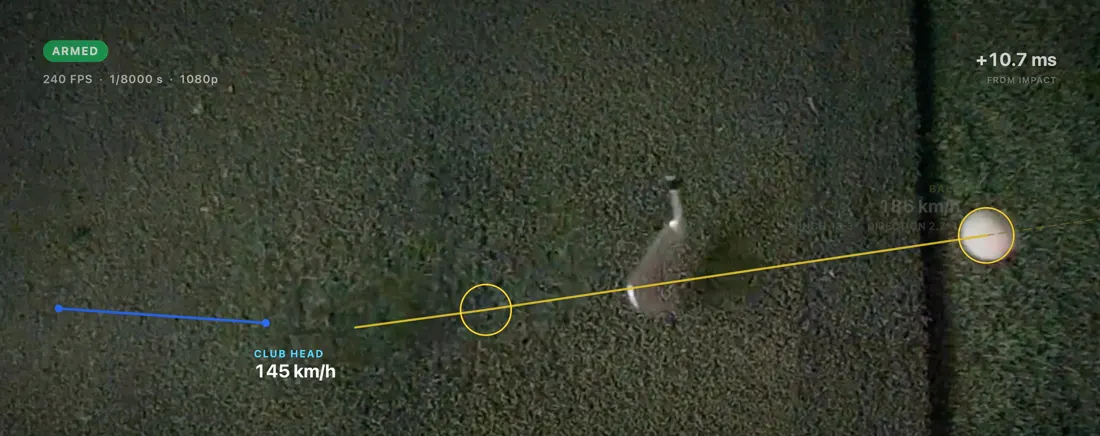
A launch monitor app uses your phone's camera at 240 frames per second. From where the ball is in each frame and how big it looks, the app calculates speed, vertical launch and horizontal direction. Everything after that comes from a flight model. With one camera and a plain white ball, spin cannot be seen, so it is estimated from club, speed and launch.
Where a phone keeps up
Ball speed and launch angle drive most of your carry. A camera at 240 fps sees the ball for a handful of frames after impact, which is enough to fit a straight line through its path in three dimensions. If the camera knows exactly how far away and how high it is, speed and launch come out close to what a radar reads.
How close? DeepSwing's developers compared the app side by side with a Rapsodo MLM2 PRO in ten sessions in late September 2026, iPhone 17 Pro on a tripod, clubs from driver to lob wedge, about 150 paired shots. With the tripod height measured correctly, the averages per session came out like this:
| Number | DeepSwing vs Rapsodo MLM2 PRO (average per session) | Shot-to-shot spread |
|---|---|---|
| Ball speed | 0 to +1 percent | 0.7 to 1.9 percent |
| Launch angle | within 2 degrees (most clubs within 1) | about 2 degrees |
| Direction | offset set by how the tripod was aimed, under 1 degree once aligned | 0.5 to 1.8 degrees |
| Carry, driver | minus 0.5 percent | |
| Carry, 5-wood | plus 0.2 percent | |
| Carry, 9-iron | plus 1.4 percent | |
| Carry, lob wedge | 0.0 percent |
Two things to read into that table. First, an MLM2 PRO is a reference, not the truth: it has its own error, so "same as Rapsodo" means "as good as a popular unit under $1,000", not "as good as a TrackMan". Second, the spread matters more than the average for practice. A spread of one or two percent in ball speed means a 7-iron that really carries 150 yards reads somewhere between 147 and 153. For gapping your clubs over ten shots, that is plenty.
Where a real launch monitor is still better
Spin
This is the big one. Driver spin decides whether a drive at 150 mph ball speed carries 240 or 220 yards, and a camera app cannot see it on a plain ball. In the same September sessions, DeepSwing's spin estimate was on average 665 rpm higher than the spin the Rapsodo measured with marked RPT balls, with a scatter of almost 1,000 rpm from shot to shot. That is fine for a realistic flight on a simulator. It is not fine if you are choosing between two driver shafts. DeepSwing labels spin as estimated, and reading spin from balls with an alignment stripe is in training.
Club data
Premium units report club path, face angle, angle of attack, dynamic loft and impact location from measurements. Camera apps are catching up here (DeepSwing reads club speed and path when it sees the club head, and xShot films the club from above), but face angle and dynamic loft from one phone are not at launch monitor level yet.
Forgiveness
A radar or photometric unit is built for one job and calibrated in the factory. A phone has to be told where it stands. If you enter the wrong height or aim the tripod a few degrees off, the numbers are off, and nothing tells you unless the app checks. A dedicated unit is also less picky about light.
Outdoor full flight
Outdoors, a TrackMan follows the real ball for 200 yards or more, which is how tour data like the TrackMan PGA Tour averages is collected. A phone, like most indoor units, sees only the first few feet and calculates the rest. That is why the flight model matters so much for any camera app.
The real error is the setup
In DeepSwing's sessions the largest errors never came from the measurement itself. They came from setup. These are the ones to watch with any camera launch monitor:
- Tripod height. The camera's height above the ball sets the scale of every measurement. One centimeter off is about one percent of ball speed. In one session the height was entered as 1.15 meters while the real lens height was 1.04 meters, and every shot read about 10 percent fast. DeepSwing now compares the entered height with the ball's size in the picture and warns when they disagree by more than 8 cm.
- Aim. Direction is measured relative to where the camera points. A tripod aimed 2 degrees left of your target makes every shot look 2 degrees right, which is 6 to 7 yards at 180 yards. Lay a club on the ground along the target line and align the phone to it.
- Light. 240 fps with a short shutter needs a lot of light. In a dim room the phone either shortens the exposure and gets a noisy picture, or lengthens it and the ball blurs.
- Ball color. Yellow range balls with soft edges once read about 13 percent too big at the range in DeepSwing's October tests, which pushed launch angles up by 5 degrees. That case is corrected in the current version, but it shows why balls with clear contrast against the ground help.
- Heat and frame drops. If the phone gets hot or another app runs in the background, it may deliver fewer than 240 frames per second. A good app tells you.
Get those right and a phone gives you numbers you can practice with. Get them wrong and even a perfect algorithm gives you nonsense.
Try it yourself: the DeepSwing launch monitor is live on iPhone with 5 free shots every week. Get the DeepSwing launch monitor, and if you own a launch monitor already, set both up side by side: that comparison tells you more than any review. DeepSwing is on the App Store and Google Play where the swing analysis works today and the launch monitor follows as an update.
What it costs
Rough US prices in October 2026, which change often:
- Camera launch monitor apps: a subscription, typically $7 to $15 a month or $70 to $100 a year (for example Golfboy or ChipIn). Some have a free tier.
- Garmin Approach R10: about $500.
- Rapsodo MLM2PRO: about $700, plus a yearly membership for the full feature set.
- Square Golf: about $700, photometric, no subscription according to retailers.
- FlightScope Mevo+: from about $1,300.
- TrackMan, Foresight GCQuad and similar: five figures.
The phone you already own is the cheapest launch monitor you can get. The question is only whether what it measures covers what you need.
Is an app enough for you?
A camera launch monitor app is enough if you want to:
- Know your real carry with every club, averaged over ten shots.
- See your dispersion and whether you start the ball left or right.
- Track whether speed training is working.
- Play a range, courses and games at home or into a net.
- Connect to GSPro casually.
Buy a dedicated launch monitor if you want to:
- Fit a driver, a shaft or a ball by spin.
- Work on face angle, path and angle of attack in degrees.
- Hit in a dark garage without extra lights.
- Get readings without thinking about setup.
There is a middle way too. Many golfers who own a radar unit still want to know why a shot went where it went. That is where swing analysis comes in: an AI golf swing analysis next to your numbers tells you what to change. DeepSwing puts both in one app, with a second iPhone or iPad filming every launch monitor shot and analyzing the swing.
For a side-by-side of the apps themselves, see the best launch monitor apps in 2026.
Your next step: get the DeepSwing launch monitor, set the tripod up with a measured height and a club on the ground, hit ten 7-irons and compare the average carry with what you think your 7-iron goes. Most golfers are surprised.
FAQ
How accurate are launch monitor apps?
With a correct setup, the best camera apps read ball speed within one or two percent and launch angle within a degree or two of a consumer radar unit. Spin is estimated by most apps and much less accurate. Setup errors (height, aim, light) cause bigger errors than the measurement itself.
Can my iPhone replace a launch monitor?
For carry, ball speed, launch and dispersion in practice: yes, if it films 240 fps, stands on a steady tripod and has good light. For measured spin and club face data: not yet.
Are phone launch monitors good enough for a home simulator?
For fun rounds and practice, yes. The flight comes from measured speed, launch and direction plus an estimated spin, which gives believable shots. Serious players who want every spin-related miss reproduced will prefer a photometric unit.
Why do launch monitors disagree with each other?
Each one measures differently and has its own error. Radar and camera units can differ by a few percent on the same shot, and indoor carry is always calculated, never measured. Compare averages over many shots, not single readings.
Do I need a launch monitor to improve?
No, but numbers help you practice honestly. Knowing that your 7-iron carries 148, not 165, changes your club choice on the course more than any swing tip.