
Published: 27.10.2026 • Read time ~12 min
Launch monitor numbers explained: what good looks like per club
Ball speed, launch, spin, smash factor and carry in plain words, with PGA Tour averages for every club and the five numbers worth watching first.
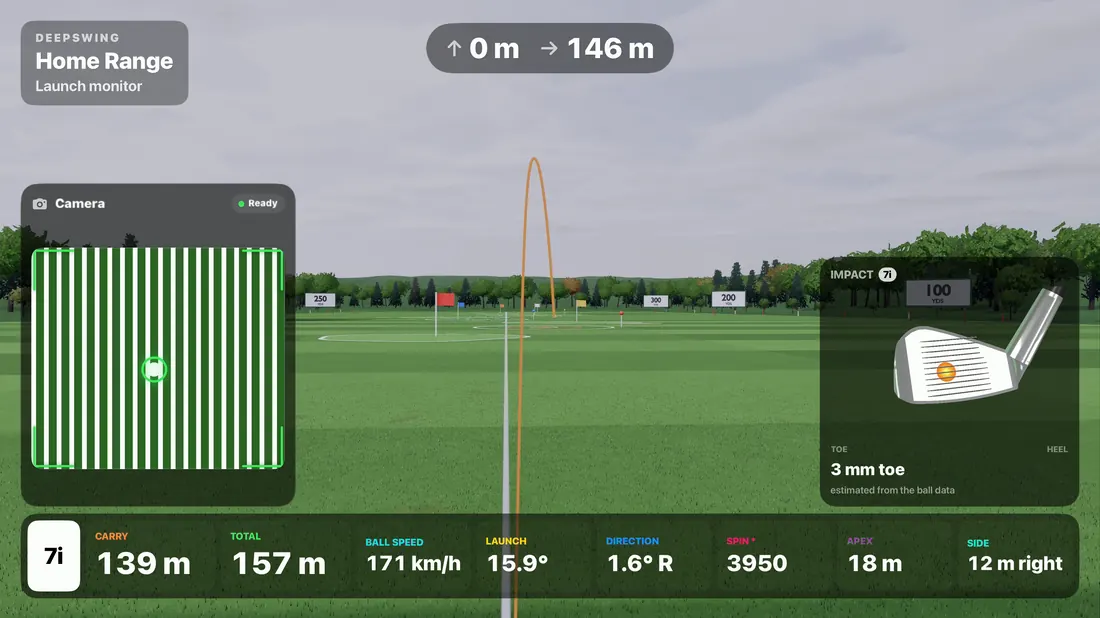
Updated November 2026. The DeepSwing launch monitor is live on iPhone in the App Store. The Android version follows as an update.
A launch monitor throws a dozen numbers at you after every shot. Five of them explain almost everything about where the ball went: ball speed, launch angle, spin, direction and carry. The rest tell you why those five came out the way they did.
This guide explains every common launch monitor number in plain words, shows what good values look like for each club (with real tour averages as a yardstick), and tells you which numbers to care about first. It works for any launch monitor, from a TrackMan to a phone app.
The five numbers that matter most
Ball speed
How fast the ball leaves the clubface, in mph or km/h. It is the biggest single driver of distance. Every extra mile per hour of ball speed with a driver is worth roughly 1.5 to 2 yards of carry, if launch and spin are sensible. Ball speed comes from club speed and from how centered you hit the ball.
Launch angle
The vertical angle at which the ball starts, relative to the ground. Too low and the ball does not stay in the air long enough. Too high and it balloons, especially with a lot of spin. The right launch depends on the club and on your speed: slower swingers need more launch with the driver to carry the ball.
Spin rate
Backspin in revolutions per minute (rpm). Spin creates lift and keeps the ball in the air, and it makes the ball stop on the green. With a driver, too much spin costs distance; with a 9-iron, too little makes the ball run through the green. On many units spin is the number with the largest difference between measured and estimated values (more on that below).
Launch direction
Also called horizontal launch angle: where the ball starts, left or right of your target line, in degrees. It mostly follows where the clubface pointed at impact. Combined with spin axis (the tilt of the spin), it decides whether the ball draws, fades, hooks or slices.
Carry
How far the ball flies in the air before it first lands. It is the number to plan your shots with, because on the course you have to carry bunkers, water and the front of the green. Total distance adds bounce and roll, which change with every fairway and every green.
The other ball numbers
- Total distance: carry plus bounce and roll. Useful for drives, much less for irons.
- Apex, or max height: how high the ball flies. Tour players hit their 7-iron about 30 to 35 yards high. If your irons do not get up, they will not stop on firm greens.
- Descent angle, or land angle: how steep the ball comes down. Steeper means it stops faster. Around 45 to 50 degrees for mid irons is a common target.
- Side, or offline: how far left or right of the target line the ball lands.
- Curve: how much the ball bends in the air from where it started.
- Spin axis: the tilt of the spin. Zero is pure backspin, positive tilts the ball right (a fade for a right-hander), negative tilts it left.
The club numbers
- Club speed: how fast the club head moves just before impact. The engine of everything.
- Smash factor: ball speed divided by club speed. It shows how well you transferred the club's speed to the ball. With a driver, about 1.50 is the practical maximum, because the rules limit how springy a clubface may be. Off-center hits drop it quickly.
- Attack angle: whether the club moves up or down at impact. Irons should hit down on the ball (negative). With a driver, a slightly upward attack angle adds distance at the same speed.
- Club path: the direction the club moves at impact, left or right of the target line.
- Face angle: where the clubface points at impact.
- Face to path: the difference between face and path. It decides the curve: face closed to path draws the ball, face open to path fades it.
- Dynamic loft: the loft the club actually delivers at impact, which differs from the loft printed on the club.
- Spin loft: roughly the difference between dynamic loft and attack angle. More spin loft means more spin, as TrackMan explains in detail.
TrackMan lists around 40 parameters in its overview. You do not need all of them. If you know the five ball numbers and smash factor, you understand most sessions.
What good looks like: tour averages per club
The most quoted yardstick is TrackMan's PGA Tour data. These are the 2023 averages as reported by Golf Monthly, with smash factor calculated from them:
| Club | Club speed (mph) | Ball speed (mph) | Smash factor | Spin (rpm) | Carry (yards) |
|---|---|---|---|---|---|
| Driver | 115 | 171 | 1.49 | 2,545 | 282 |
| 3-wood | 110 | 162 | 1.47 | 3,663 | 249 |
| 5-wood | 106 | 156 | 1.47 | 4,322 | 236 |
| Hybrid | 102 | 149 | 1.46 | 4,587 | 231 |
| 4-iron | 98 | 140 | 1.43 | 4,782 | 209 |
| 5-iron | 96 | 135 | 1.41 | 5,280 | 199 |
| 6-iron | 94 | 130 | 1.38 | 6,204 | 188 |
| 7-iron | 92 | 123 | 1.34 | 7,124 | 176 |
| 8-iron | 89 | 118 | 1.33 | 8,078 | 164 |
| 9-iron | 87 | 112 | 1.29 | 8,793 | 152 |
| Pitching wedge | 84 | 104 | 1.24 | 9,316 | 142 |
Two things stand out. Smash factor drops as loft goes up, so a 1.25 with a wedge is perfectly normal, while a 1.25 with a driver means a mishit. And tour spin climbs by roughly 1,000 rpm per club through the irons, which is why their irons land soft.
Do not compare your carry to this table and despair. Tour players swing a driver 115 mph, and the PGA Tour's own driving distance stats show them averaging around 300 yards in total. The average male golfer with a handicap hits his drive about 215 yards in total, according to Arccos data published by the USGA and the R&A and quoted in another Golf Monthly piece. The useful comparison is the shape of the numbers, not their size. If your speeds are closer to the women's tour, the LPGA statistics are a better yardstick than the men's.
What is a good ball speed?
Driver
As a rough guide for carry with a decent launch and spin: 130 mph ball speed carries about 205 to 215 yards, 150 mph about 240 to 250, and 170 mph about 280. If your driver ball speed is under 1.45 times your club speed, centered contact is the cheapest distance you will ever find.
7-iron
Tour average is 123 mph for 176 yards of carry. Ball speeds around 100 to 110 mph, which many amateurs reach, carry roughly 135 to 155 yards depending on launch and spin. A 7-iron smash factor of 1.30 to 1.38 is good.
Wedges
Full pitching wedges carry 142 yards on tour at 104 mph ball speed. With wedges, speed matters less than control: the goal is the same carry within a few yards every time.
Launch and spin: the windows that matter
With the driver, launch and spin work together. A high launch with low spin carries farthest. For a typical amateur with 90 to 100 mph club speed, launching the driver at 13 to 16 degrees with 2,200 to 3,000 rpm is a sensible window. Faster swingers can launch lower and still carry far. If your driver spins 3,500 rpm or more and launches low, look at your attack angle first: hitting down on the driver adds spin and takes away launch.
With irons, you want enough spin and height to stop the ball. A rough rule many fitters use: 7-iron spin near 1,000 times the club number (7,000 rpm for a 7-iron) for strong players, less for slower swingers. Peak height matters more than the exact spin: if your 7-iron comes down steep (around 45 degrees or more), it will hold the green.
Which numbers to look at first
- Average carry per club, over ten shots. This is the number that changes your club choice on the course. Most golfers think their 7-iron goes 10 to 15 yards farther than it does.
- Dispersion: how far left, right, short and long your ten shots spread. A tight 7-iron that is 5 yards short is better than a long one that is all over the place.
- Launch direction: where the ball starts. If your shots start right and stay right, the face is open at impact.
- Smash factor: if it is low, work on centered contact before you work on speed.
- Only then: spin, attack angle, path and face.
What a phone launch monitor can show you
Phone apps film the ball at 240 frames per second. From that video they measure ball speed, launch angle and launch direction, the three numbers that matter most. Club speed can be read when the camera sees the club head. Carry, apex, total distance and curve come from a flight model. Spin is estimated from the club, the speed and the launch, because one camera cannot see a plain white ball rotate.
So with a phone, you get reliable numbers for the first three steps of the list above (carry per club, dispersion, start direction), which is exactly what most golfers need. For spin, spin axis, face and path in degrees, you need a radar unit like the Garmin Approach R10, a radar and camera unit like the Rapsodo MLM2PRO, or a photometric launch monitor from Foresight. We go into the accuracy question in launch monitor app vs real launch monitor.
The DeepSwing launch monitor shows carry, total, ball speed, launch, direction, apex and side for every shot, labels spin as estimated, and keeps a per-club summary with averages and dispersion that you can export as a PDF. It is live on iPhone with 5 free shots every week: get the DeepSwing launch monitor. If you want to see why a number came out the way it did, the swing analysis is already in DeepSwing on the App Store and Google Play, with a 7-day free trial of the yearly plan.
Indoors vs outdoors
Indoors the ball hits a net or screen after a few feet. Every launch monitor, radar or camera, then calculates carry and total from the launch numbers instead of watching the ball land. That is why your indoor 7-iron and your range 7-iron can differ by a few yards on the same unit. Outdoors, a radar can track the real flight, while a camera unit still calculates it. Wind, temperature and altitude change real carry too: the same shot flies farther in warm, thin air.
How to use your numbers in practice
Here is a 30 minute session that gives you a yardage list you can trust:
- Warm up with ten easy wedges. Do not look at the numbers.
- Hit ten shots each with pitching wedge, 7-iron and driver at your normal on-course swing. Not your hardest.
- Ignore the best and the worst shot of each club. Write down the average carry of the other eight.
- Note where the misses go. If eight of ten 7-irons start right, that is your next practice topic.
- Next week, add 9-iron, 5-iron or hybrid, and 3-wood. In three sessions you have your whole bag.
Then fix what the numbers point to. If your start direction is the problem, a slice fix is a better use of the next session than chasing speed. If your smash factor is low, centered contact first. If you want more speed, track it per club with a swing speed measurement and see whether your training works.
Make it your first session: get the DeepSwing launch monitor and run the 30 minute session above. You will leave with a yardage card for your bag and the one miss to work on next.
FAQ
What launch monitor numbers are most important?
Ball speed, launch angle, spin, launch direction and carry. They explain where the ball went. Smash factor, attack angle, path and face explain why.
What is a good smash factor?
About 1.45 to 1.50 with a driver, 1.30 to 1.38 with a 7-iron and 1.20 to 1.25 with a pitching wedge. Lower values with the same club usually mean off-center contact.
What is a good ball speed for a driver?
It depends on your club speed. About 1.45 to 1.50 times your club speed is efficient. Tour players average 171 mph, many amateurs are between 120 and 150 mph.
How far should I hit my 7-iron?
Tour players average 176 yards of carry. Most amateurs carry it somewhere between 130 and 160 yards. Measure your own average over ten shots: that is the only number that helps you on the course.
Is carry or total distance more important?
Carry, for every club except the driver. Bounce and roll change with every lie and green, carry does not.