


Down-the-line analysis
Down-the-line analysis: where the swing plane tells the truth.
From behind, on the target line, you see swing plane, path and posture. DeepSwing detects the down-the-line view, draws the swing plane from the clubhead path and measures what only this view reveals.
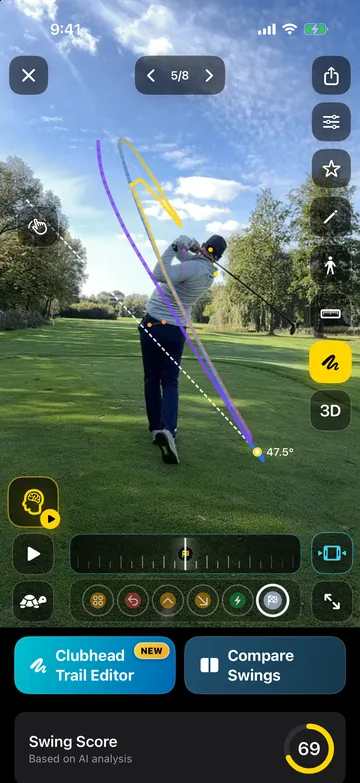
- Autoview detection
- 20+checks
- 1tripod is enough
- 6phases
Setup
The right camera position.
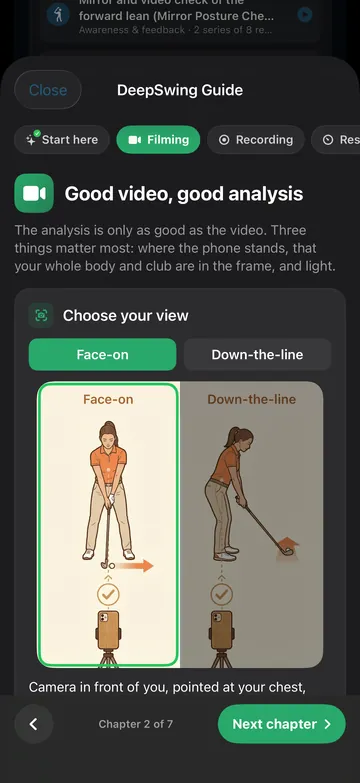
Down-the-line analysis is only as good as the camera position: on the extended target line, the whole body and the club in frame. The starter guide shows step by step where the phone goes.
- Guide with illustrations
- View is detected
- Same position, comparable values
Swing plane
The plane from your clubhead path.
DeepSwing measures the swing plane on the detected clubhead path in the backswing and downswing and shows whether the club runs above or below the line. Over the top is measured on the path.
- Plane in backswing and downswing
- Over the top
- Shaft lean and casting
Posture
Posture and hip depth, phase by phase.
Spine angle, early extension, flying elbow and hand depth at the top: the down-the-line checks show whether you keep your posture through the swing.
- Early extension
- Flying elbow
- Posture loss

Draw
Your lines, your reference.
Draw your own plane lines on the video and compare today's swing phase-synced with your reference swing.
- Lines and angles
- Phase-synced comparison
- 3D ghost from behind, too
How it works
- 1
Place the camera
Behind you on the target line, whole body and club in frame.
- 2
Record
DeepSwing detects the view and uses the matching checks.
- 3
Read plane and path
Swing plane, over the top and posture with lines drawn in.
What golfers say
4.6 out of 5 · 126 App Store ratings
-
★★★★★ App Store
Super helpful
I have played golf for years and always want to improve my swing. The app is super helpful because you can upload your own videos and analyze them right away. It recognizes the swing and gives really good tips for improving. Highly recommended!
Bosa2010 · Germany · Translated from German -
★★★★★ App Store
Helpful AI analysis for better golf
I have been using DeepSwing for a few weeks and I love it. The app analyzes my swing, especially my tee shots, and shows me right afterwards what I can do better. Much better than ordinary video apps. …
Zubabua · Germany · Translated from German -
★★★★★ App Store
Game changer!
I have been using this app for several months and it has helped me so much. … One of the things I like most is that I can experiment with different grips or moves and see the impact immediately. … I have never hit the ball better and my consistency has improved dramatically.
JMDOS · Canada ·
Questions, answered
Where exactly should the camera be for down-the-line?
Behind you on the extended target line, so your whole body and the club are in frame. The guide in the app shows the position.
What does down-the-line show that face-on does not?
Swing plane, over the top, hip depth and early extension. Face-on shows sway, weight shift and head movement better.
What is over the top in the view from behind?
In the downswing the club comes over the path of the backswing. DeepSwing measures it as the gap between the two clubhead paths.
Do I need a second person to film?
No. Phone on a tripod, start autocapture or use Apple Watch as a remote.
Why does my swing look different from how it feels?
Feel and reality differ for almost every golfer. That is exactly why video and measured values help: they show what really happens.
Related topics